This article by the NYT highlights probably Lebanon's most crucial moment in recent times. It is the fight between Iran and the USA over who controls the smallest country in the area. And we stand smack in the middle...still emotionally recuperating from the summer 'heat'.
mrtez
By Michael SlackmanThe New York Times
November 5, 2006
BEIRUT: Not long before the 34-day war with Israel, political groups in Lebanon aligned with the United States sat at a table with Hezbollah and tried to get it to give up its weapons and to help remove the pro-Syrian president from office.
On Monday, most of those same political leaders will sit down again, but this time the issues of Hezbollah's weapons and the president's tenure are not even on the agenda.
Instead, having proclaimed itself the victor in the summer war with Israel, the tables have turned. Hezbollah is pressing its case for effective control of the government and a new election law - warning that if it does not have its way, it will move to bring down the government and force a new parliamentary election.
On one level, this is a parochial fight over who runs a Mediterranean nation of four million people. But Lebanon has long been a proxy chessboard in the great global game of geopolitics, its people often finding their own interests subjugated to the interests of more powerful foreign nations.
Hezbollah, an ally of Iran and Syria, has been emboldened. The U.S.-backed coalition in control of the government is on the defensive. The outcome of the tug- of-war could have lasting impact on the international order - boosting or slowing Iran's ascent in the region, buttressing or undermining Syria's leadership.
"We are now calling for unity and accord, not for score-settling and vengefulness," Hezbollah's general secretary, Hassan Nasrallah, said in a recent appearance on his party's Al Manar television. "We are suggesting a national unity government in a positive spirit."
But his call has not been received that way. It has been described by the governing coalition as a "coup d'état" and has raised fears of possible violence.
"They are making a profit from the strength of their guerrilla force to come into the capital and to pressure the political apparatus, to impose their will on the government," said Amine Gemayel, a former president and leader of the small Christian Phalange party, part of the governing coalition. "I am quite anxious about this meeting."
Hezbollah's demands, including veto power over cabinet decisions, are the latest development in a constant jockeying for power between political groups organized along religious lines. While over the generations, power has essentially shifted from Sunni Muslims, to Christians, and now, perhaps to the long-neglected Shiite Muslims - often with political alliances between the different factions - the conflict has underscored the combustible nature of a system that demands allegiance to sects and promises each of Lebanon's 18 sects an equal say in decision-making.
"In many ways it is a system of coexistence, of compromise," said Walid Sharara, an opinion writer with the newspaper Al Akhbar. "But it is also, in a way, a cold civil war. In order for sectarian elites to maintain their power, they have to incite sectarianism."
The political fight has complicated efforts at rebuilding, a task already complicated by its balkanized population. There are effectively no true political parties in Lebanon. Sunni Muslims belong to a Sunni Muslim party. Shiites to a Shiite party. Druse to a Druse party. Christians to a Christian party.
Lebanon is a state built on a promise that all sects will share power, that Muslims and Christians will each control half the Parliament. The president must be a Christian. The prime minister a Sunni. The speaker of the parliament a Shiite. Public loyalty is to sect leaders - and not the state.
Khaled Arab, 53, a Sunni Muslim, lives in the largely Druse and Christian village of Choueifat, about 45 minutes outside of Beirut. The village square and shops sport pictures of Druse leaders, such as Walid Jumblatt. But when Arab's father had a heart attack, he turned for help to Saad Hariri, the leader of the largest party representing Sunni Muslims. "The leader of my sect looks after my interests," he said. "This applies to all other sects, too. This is how the country is and there is nothing we can do about it."
There is fear now that the latest fight will spill into the streets, that Hezbollah will hold true to its threat and call its supporters to demonstrate if it does not get its way. Many fear that could spark violence.
"The reality is the country is not changeable," said Timur Goeksel, the former long-time spokesman for UN forces in Lebanon. "If you push too hard, it will collapse. Let's keep what we have and not shoot at each other."
Hezbollah says it wants a national unity government that would drain power from the so-called March 14th coalition, which is backed by the United States. Nasrallah has been forceful and threatening in making his demands.
"We can instigate civil disobedience, topple the government, and bring about early elections," he said in his television appearance. "But we are not threatening to do this, so don't scare us with talk of civil strife or civil war, since neither of these is a possibility."
In concrete terms, it is impossible to say if Hezbollah has emerged stronger or weaker from the war with Israel. Polls show it has the most public support, but even political analysts here acknowledge it is impossible to truly trust any assessment in a country where it appears no one is a neutral observer.
Hezbollah has gained strength from its alliance with General Michel Aoun, leader of a large Christian party. But it is impossible to know if General Aoun has maintained or lost support of his followers for having forged an alliance with Hezbollah.
"Hezbollah is now drawing support from Christians," said Abdo Saad, director of the Beirut Center for Research and Information. "That was not thinkable before the war."
But Hilal Khashan, a professor of political science at American University in Beirut said, "Hezbollah thinks if there is an election now, they will win a majority. Absolutely not."
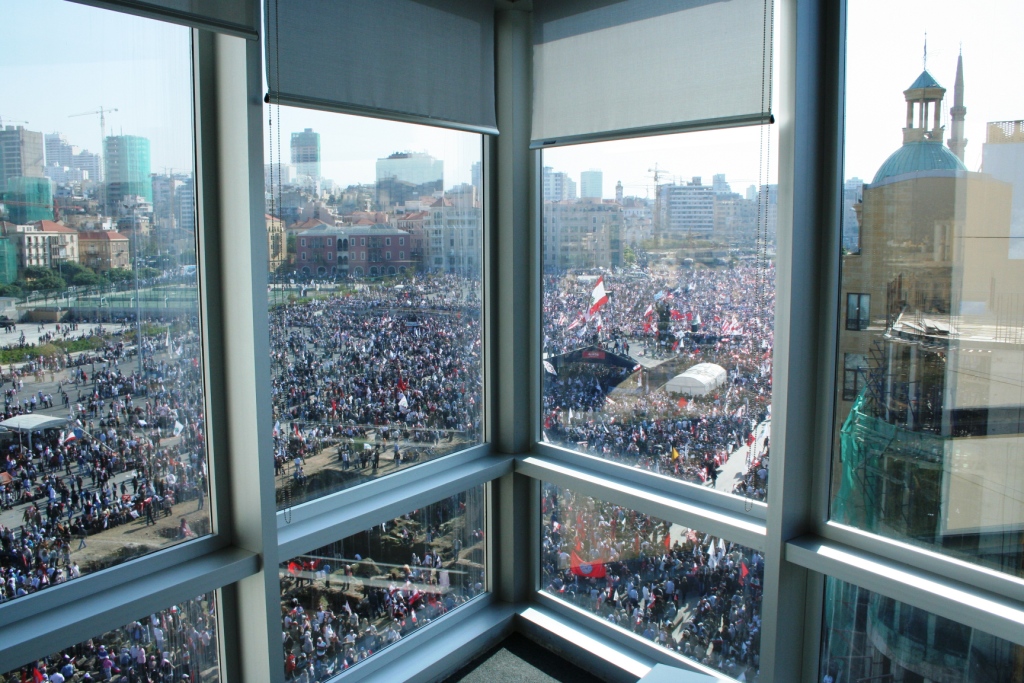 Picture taken on November 23, 2006 from the An-Nahar offices.


